We have chosen for you. It’s not the right location? You can change it anytime.


Cyber security: a priority at all times
Managing the risks related to your financial security is central to your relationship with your advisor. So is managing your computer security risks.
April 26, 2023
Experts say that by the end of 2023, the number of devices connected to the Internet will exceed 25 billion worldwide, or three times the number of people on earth. According to computer security experts, the diverse nature of these devices and their operating systems give rise to any number of vulnerabilities, which computer hackers are very good at exploiting.
But what exactly are these cyber threats and what steps are taken to protect the information you exchange with your advisor?
A multi-headed monster
The Canadian Centre for Cyber Security, an initiative of the federal government, defines a cyber threat as “an activity intended to compromise the security of an information system by altering the availability, integrity, or confidentiality of a system or the information it contains, or to disrupt digital life in general.” Cyber threat actors can have different motivations: political, ideological, financial, and so on.
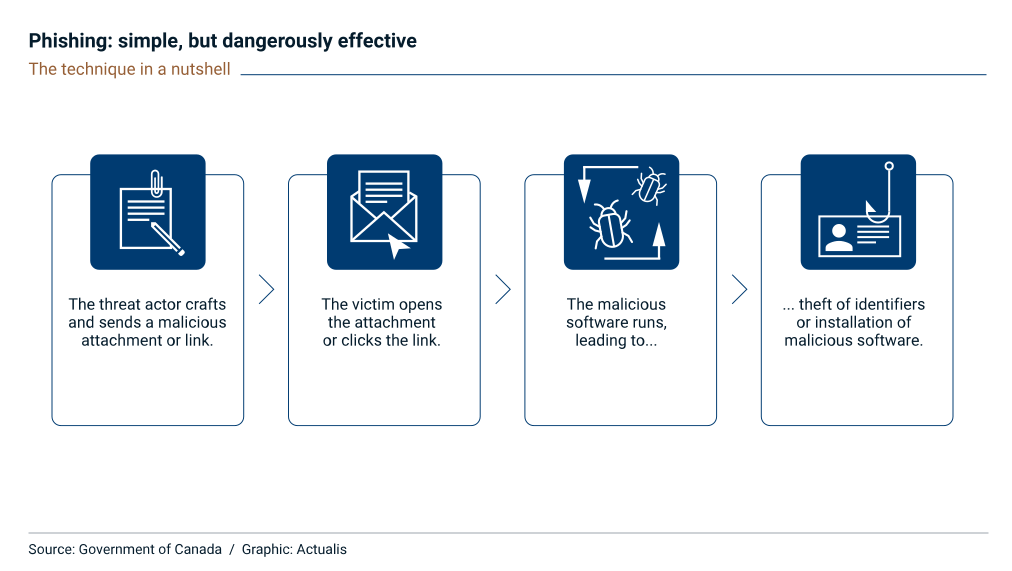
Among the many tactics used, phishing is the most widespread and is behind about 36% of security breaches. This is a common technique where threat actors disguise themselves as a trustworthy entity in order to get the recipient of an email or text to reveal personal information, such as login credentials or banking information. It is estimated that as many as 3.4 billion phishing emails are sent every day.
Which raises a question: what about the information that you exchange with your advisor?
Protecting information within the advisor-client relationship
The measures implemented to protect your information are primarily technological and procedural.
From a technological standpoint, your advisor is responsible for having security measures in place at all times. Specifically, advisors are required to use secure devices, ensure safe access management, and properly store and share confidential information based on strict standards. They must also comply with various rules governing the protection of clients’ personal information and with frameworks established by the regulatory authorities. Advisors are also given regular training sessions on cyber threats, cyber security and procedural requirements to ensure that they always have up-to-date knowledge and appropriate practices.
With the growing number of connected devices, cyber security is only going to become a greater priority all the time. To learn more and find out what good security practices you yourself can adopt, the federal government’s Get Cyber Safe , You will be redirected to an external website. website might be a good place to start. And feel free to discuss this topic with your advisor, as well.
The following sources were used to prepare this article:
Espace CDPQ, “Connected economy: Beyond the object, the data , You will be redirected to an external website..”
Canadian Centre for Cyber Security, “An introduction to the cyber threat environment , You will be redirected to an external website..”
Splunk, “Phishing Scams & Attacks: What To Expect in 2023 , You will be redirected to an external website..”
Government of Canada, “Get Cyber Safe , You will be redirected to an external website..”