We have chosen for you. It’s not the right location? You can change it anytime.



What’s the right age to purchase life insurance?
A few guidelines to assess your needs and determine an appropriate amount.
September 21st, 2026
As we move forward in life and career, new financial realities develop and we become more aware of questions that, previously, hadn’t seemed very pressing. One of these might be, “Is it time to buy some life insurance?” After all, shouldn’t everyone consider life insurance coverage?
Actually, that might be looking at the question from the wrong angle.
Responsibilities, not age
Life insurance is designed first and foremost to meet one need: to ensure that your loved ones are not faced with major financial difficulties in the event of your death. And while it’s true that our level of responsibility for other people often increases with age, it is the responsibility, not the number of years, that dictates our coverage needs.
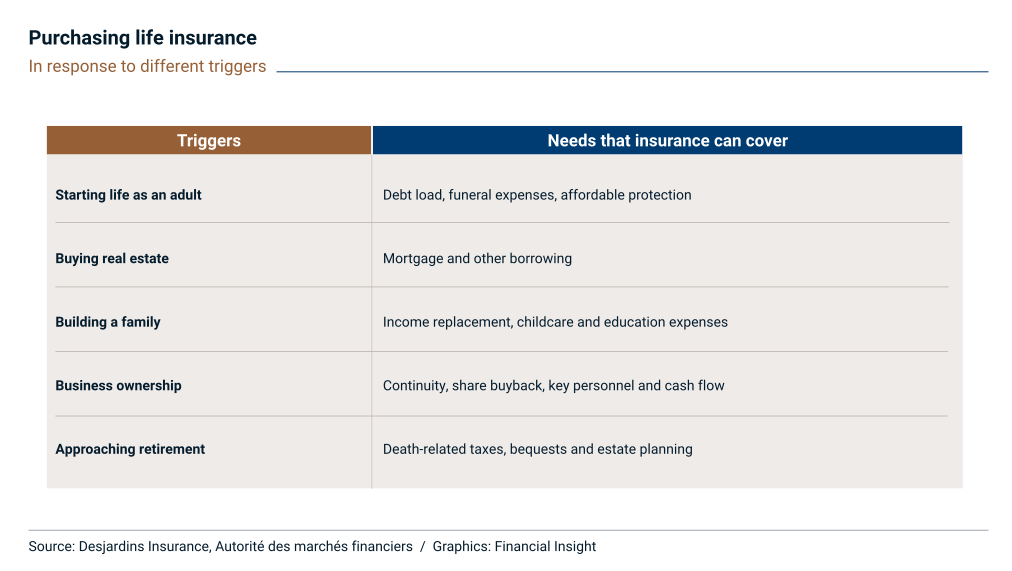
As shown in the following table, a young adult just starting out, with no financial dependents, may have little need for protection and might consider minimal coverage, or even none at all if he or she has substantial savings. On the other hand, if this same young adult is entrepreneurial and starts a business with partners right after finishing school, he or she might want to get coverage that will ensure the continuity of the business in the event of his or her death. The same goes for buying real estate, getting married or retiring: different triggers give rise to different needs.
Purchasing early remains an advantage
That said, it is still generally advantageous to buy life insurance sooner rather than later. There are two reasons for this.
The first is cost. A younger person would normally pay less for a given level of coverage, because premiums are determined largely by age, health status and life habits – risk factors that grow in importance over the years.
The second reason is insurability. A policy purchased when you are young and in good health may allow you to retain your coverage even if a medical problem develops later, providing the policy is still in force. And, in the case of permanent life insurance, this means that you could be covered for the rest of your life.
The other question: how much?
Once the need has been established, the amount of coverage still has to be determined. A life insurance policy generally provides for the payment of a death benefit, and the amount of this lump sum should be gauged on the basis of immediate and future requirements.
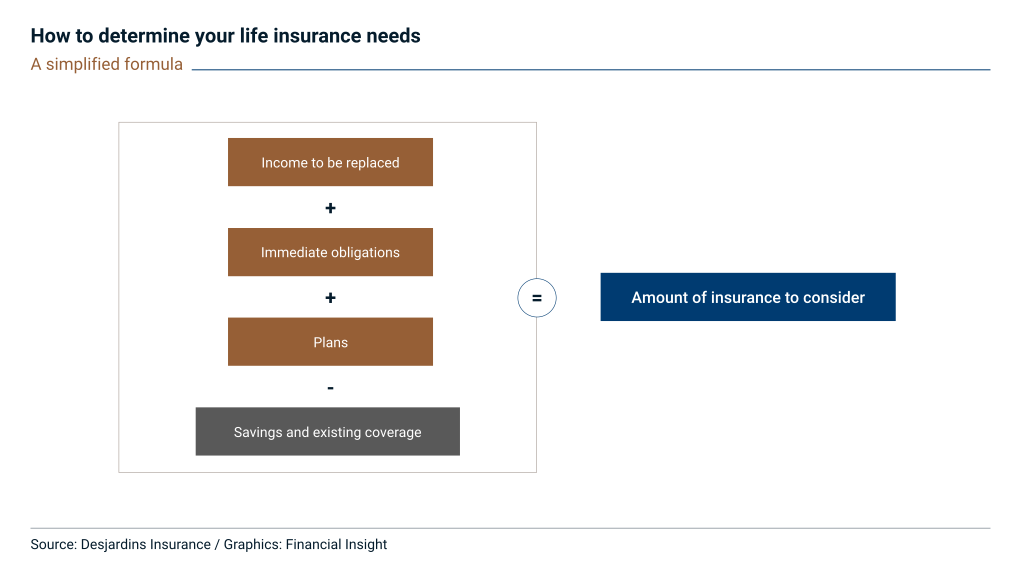
A simplified formula consists of multiplying your annual income by a factor of 7 to 10. Using this method, someone earning $70,000 a year would get a rough estimate of $490,000 to $700,000. This method provides an order of magnitude, but it can’t account for each person’s specific situation. A more precise analysis might instead look at four broad categories:
Income to be replaced
that is, the amount your loved ones would need to maintain their standard of living for a certain number of years
Immediate obligations
such as the outstanding balance on a mortgage and other debts, death-related expenses, and any taxes or costs that might have to be paid by the estate
Future plans
children’s education, daycare or support for a dependent fall into this category
Available resources
savings, investments and other types of insurance could reduce the coverage required.
The calculation can be summarized as follows:
For a business owner, the analysis might also include the repayment of commercial loans, the buyback of shares by business partners or the costs associated with replacing a key employee.
Term or permanent?
Different types of insurance could be considered, depending on the identified needs. The two main categories are term life insurance and permanent life insurance.
Term life insurance, as its name implies, lasts for a specific length of time, for example, 10, 20 or 30 years. At the end of this term, the policy can be renewed (usually at a higher premium), if desired. Term insurance addresses a need for coverage over a limited time period, such as having a mortgage or young children, and makes it possible to get adequate coverage starting at a more accessible price.
Permanent life insurance, on the other hand, can offer lifelong coverage, providing the terms of the policy are met. Depending on the specific product, the premiums or cost of insurance can be fixed or variable. The initial cost is generally higher than for comparable coverage under a term insurance policy. Some permanent life insurance policies also include a cash surrender value that may or may not be guaranteed and which can gradually build up. This cash value and how it can be used will vary depending on the product and the terms of the policy. (For more information, read this article.) In particular, permanent life insurance can meet a long-term need for protection or estate planning. Note that 100-year term insurance policies are also available. These are essentially permanent insurance with no cash surrender value.
As we can see, age is not enough to determine the right time to purchase life insurance: it all depends on your responsibilities, needs and insurability. It is also a good idea to reassess your coverage at various life stages. Your advisor can help you define your needs and decide on the appropriate solutions.
The following sources were used to prepare this article:
Autorité des marchés financiers, “Life insurance.”
Desjardins, “Life insurance”; “Permanent life insurance”; “Term life insurance.”
Get Smarter About Money, “What is life insurance and how much do you need?”
Government of Canada, “Life insurance.”
RateHub, “How much life insurance do I need in Canada?.”
SFL, “Life insurance as an investment?”; “Too young for life insurance?”; “Everything you always wanted to know about term life insurance.”