We have chosen for you. It’s not the right location? You can change it anytime.



Everything you always wanted to know about term life insurance
Affordable life insurance that provides short or medium-term protection for the things that really matter.
March 25th, 2026
When it’s time to purchase life insurance, one of the first options you will come across is known as “term insurance.”
What, exactly, does “term” mean and under what circumstances should you consider this type of coverage?
Simple, flexible insurance
First, remember that the purpose of any life insurance product is to protect the financial security of your loved ones, or the viability of your business, in the event of your death. Term life insurance focuses on this basic function. It is insurance coverage in its simplest form.
The way it works is very simple:
with the assistance of your advisor, you explore your needs and decide on the amount of coverage required, say $200,000, for instance
you determine the length of time this coverage will be needed: 10 years (known as T10 insurance), 20 years (T20 insurance), and so on
your premium will be fixed for this initial term
at the end of the term, assuming you are still alive, the policy can be renewed under the same conditions (usually at a higher premium), changed to provide more or less coverage, or simply terminated if the coverage is no longer required
on the other hand, if you should die while the policy is still in force, your beneficiaries would receive the stipulated death benefit as a tax-free payout.
Note that the younger and healthier you are, the more affordable your personal premium could be for any length of term, given that you represent a lower risk for the insurer. Generally speaking, though, the longer the term, the older you are or the more risk factors you have, the higher the premium will be.
Why consider it?
Term life insurance is particularly attractive for any person, household or business in need of specific, time-limited coverage due to substantial financial commitments: business projects, mortgage, large loans while still working or recently retired, and so on. With premiums that are generally more affordable than for other insurance products, term insurance can provide sufficient coverage offering a (usually) tax-free payout to the designated beneficiaries in order to help them with the financial burden associated with the insured person’s death:
funeral expenses
the insured’s personal debts
death tax, if any
corporate share buyback and financial commitments, if any
the additional financial load for the surviving spouse, who will now be solely responsible for maintaining the family’s standard of living.
Term insurance is also very flexible. As your need for coverage changes – for example, if your mortgage decreases or your children become independent adults – based on your policy’s terms and conditions, you can adjust the amount of coverage you have, or even terminate the policy. Finally, note that some policies may offer complementary protection, such as accident coverage, and could include support services during difficult times.
How does it compare?
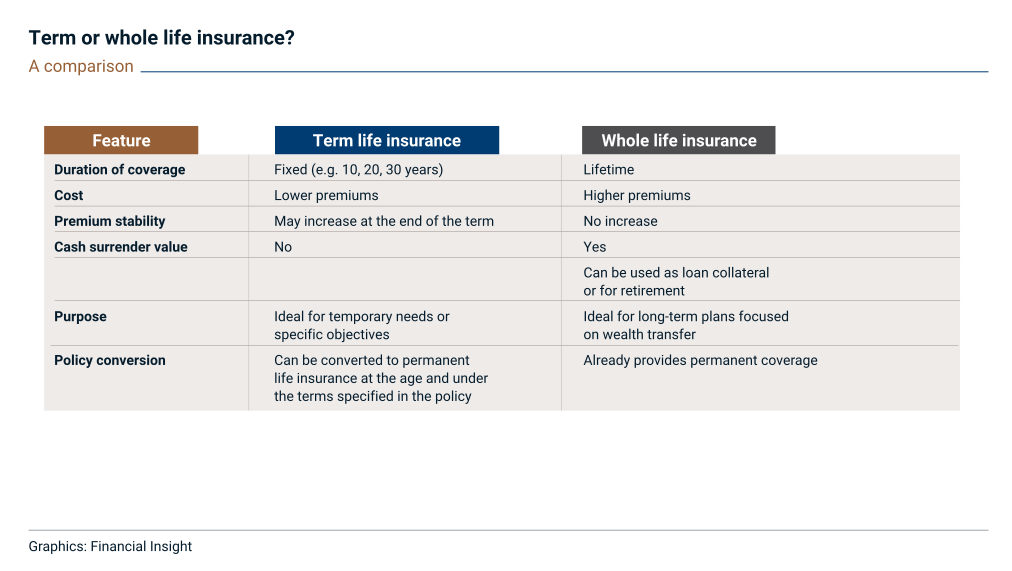
Term insurance can be compared with products known as permanent life insurance. The most familiar of these is whole life insurance, which has a capital accumulation component in the form of a cash surrender value included along with the insurance coverage. This cash surrender value is an amount that grows over the years and can eventually be used in a variety of ways, in particular: to increase the death benefit, suspend premium payments; provide loan collateral; or simply be withdrawn as cash (see this article to learn more).
Whole life insurance has no maturity date: the premiums are usually higher than for term insurance, but they remain steady for as long as the policy is in force.
While term insurance is primarily oriented towards coverage, whole life insurance fits into an approach where financial protection is combined with building and transferring wealth, and can function as a tax-efficient tool within some estate planning strategies.
T100: term insurance that is… permanent
Finally, it’s worth noting that there’s a middle way between these two types of insurance. Some insurers offer coverage with a 100-year term, or T100, which, for all intents and purposes, is permanent insurance with fixed premiums for the duration of the policy, but with no cash surrender value. The premiums are generally higher than for shorter terms, but, given the lack of a cash surrender value, T100 insurance would typically be more affordable than a comparable whole life policy.
As well, if your needs tend more toward permanent insurance, be aware that, in addition to whole life insurance, other types of permanent insurance policies could also be considered, depending on what you, your household or your business require.
There are many factors to consider when choosing among all these solutions. Review these with your advisor before making a decision.
The following sources were used to prepare this article:
Autorité des marchés financiers, “Term insurance”; “Participating and non-participating whole life insurance.”
Government of Canada, “Life insurance.”
Investopedia, “A Guide to Term Life Insurance: Types, Advantages, and Disadvantages.”
Desjardins, “Term life insurance.”
La Presse, “Temporaire, entière ou universelle : quelle assurance vie choisir ?”
Assuris, “Term to 100.”