We have chosen for you. It’s not the right location? You can change it anytime.



Split and save
How one simple strategy can offer year after year of tax savings in retirement.
March 25th, 2026
Retirement is a special time: retirees want to make the most of every minute and enjoy the standard of living that decades of hard work and saving have made possible. Did you know that by splitting your retirement income with your spouse, you might be able to afford even more of these treasured moments?
Here’s how.
A matter of tax
Pension income splitting is based on a very simple principle: judicious use of the different tax brackets that often apply to spouses.
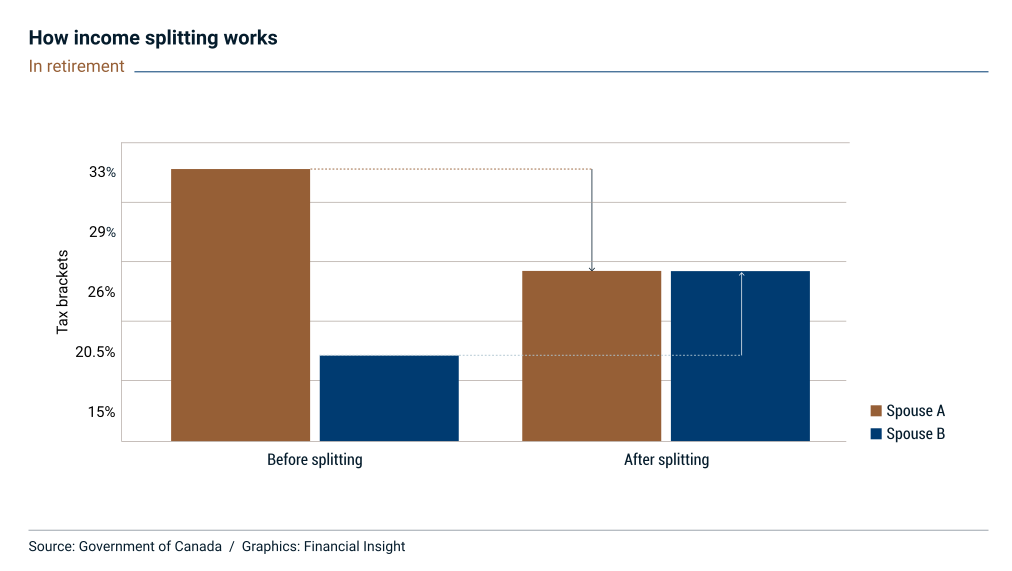
This is illustrated in the following diagram. In this example, Spouse A has enough pension income to be in the highest tax bracket (federal tax brackets are used for the purpose of this example). Spouse B, on the other hand, is in a lower tax bracket. By splitting income with B, A drops down two tax brackets. As a result, B will likely move to a higher tax bracket, but the combined tax paid by the couple could be less than it would be without the income splitting.
What’s the process? There are two commonly used methods.
Method 1: pension income splitting
The first method was made part of the Income Tax Act in 2007 and its name says it all: pension income splitting. This provision allows taxpayers to allocate up to 50% of their income to their spouse when filing an income tax return. This is merely an allocation “on paper” for tax purposes: no money actually changes hands.
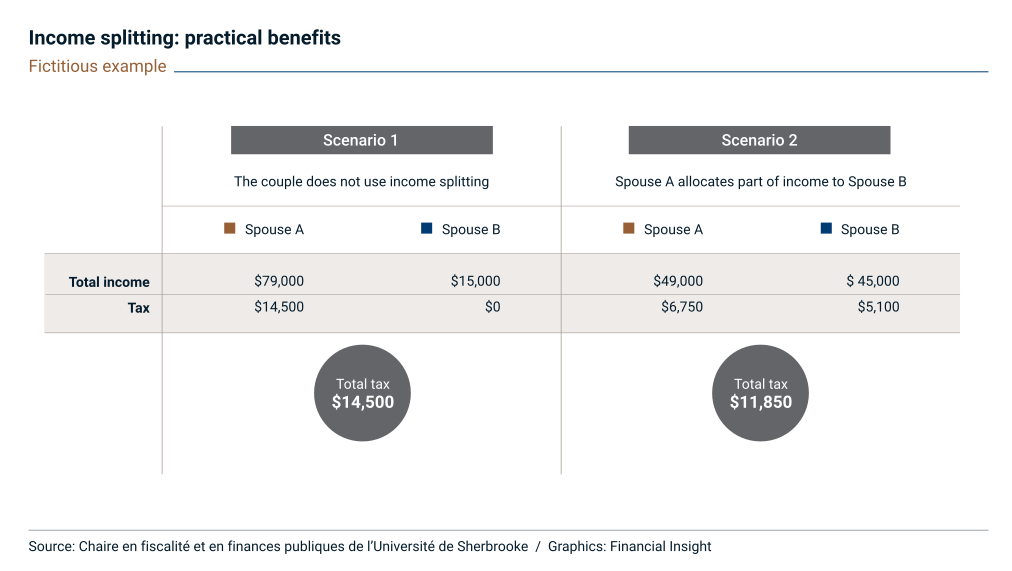
In the following example, one spouse’s income is much higher than the other’s. In Scenario 1, the couple does not split their income. In Scenario 2, Spouse A allocates a certain amount of income to Spouse B. The result: the couple’s total tax bill is reduced by over $2,500.
(Please note that the calculations shown here are for illustrative purposes only, to indicate approximate orders of magnitude.)
This type of income splitting might also have a positive impact on certain income-based tax credits. As well, it could reduce or eliminate the Old Age Security (OAS) clawback if personal income exceeds the applicable threshold.
To be clear, not all pension income qualifies for splitting. In particular, Canada Pension Plan (CCP), Quebec Pension Plan (QPP) and Old Age Security (OAS) benefits are not eligible. Conditions associated with age and province of residence may also apply. Professional advice is recommended to avoid any confusion.
Method 2: spousal RRSP
There is another way to split retirement income – but it requires advance planning during your working life. The higher-earning spouse is allowed to contribute to a spousal RRSP on behalf of the lower-earning spouse. The contributor receives the tax deduction, but the actual contributions belong to the other spouse. In this case, there is an actual transfer of funds, not just a ledger entry.
The purpose of a spousal RRSP is to mitigate an imbalance in a couple’s respective retirement savings while they are still working. Upon retirement, this could result in lower income for the contributing spouse and higher income for the receiving spouse, which, in practical terms, is a form of income splitting. Note that special rules apply to spousal RRSPs. For example, withdrawals made in the three years following a contribution might be attributed to the contributing spouse for tax purposes. Here, too, advice can be invaluable.
What about the public plans?
As mentioned earlier, CPP and QPP benefits do not qualify for pension income splitting. However, the law allows spouses to share their benefits in another way. In effect, one spouse can choose to divide his or her pension benefits and transfer a portion to the other spouse. Unlike pension income splitting, in this case there is a real transfer of income each year, not simply an allocation on paper. In some situations involving income disparity during the working life, this sharing could result in a different distribution of taxable income and, at times, tax savings.
As we can see, retired couples with different income levels have a number of ways to reduce their taxes. It is believed that pension income splitting alone could benefit about 1.5 million Canadian taxpayers, resulting in total combined tax savings of close to $1.9 billion each year.
If you think you might be one of them, talk to your advisor.
The following sources were used to prepare this article:
Chaire en fiscalité et en finances publiques, École de gestion de l’Université de Sherbrooke, “Fractionnement du revenu de pension et fractionnement des revenus de retraite entre conjoints.”
Government of Canada, “Tax rates and income brackets for individuals”; “Pension income splitting”; “Pension Sharing.”
Institute of Financial Planning, “Le fractionnement de revenu en planification financière.”
Ontario Pension Board, “Income splitting—a smart strategy for retired couples.”
SFL, “Comment utiliser le fractionnement de revenu et le REER de conjoint à la retraite.”