We have chosen for you. It’s not the right location? You can change it anytime.



How does the bond market work?
A natural complement to stocks in an investment portfolio, bonds are based on very different principles.
February 19th, 2026
If you have a diversified portfolio, it likely contains some stocks, perhaps in the form of a mutual fund composed of Canadian, U.S. or international equities, and some bonds, perhaps in the form of a bond fund. It’s also possible that you own a balanced fund that combines these two components. In each of these cases, the “bond” portion of your portfolio has some very specific characteristics.
Here’s what you need to know.
The bond: a debt security
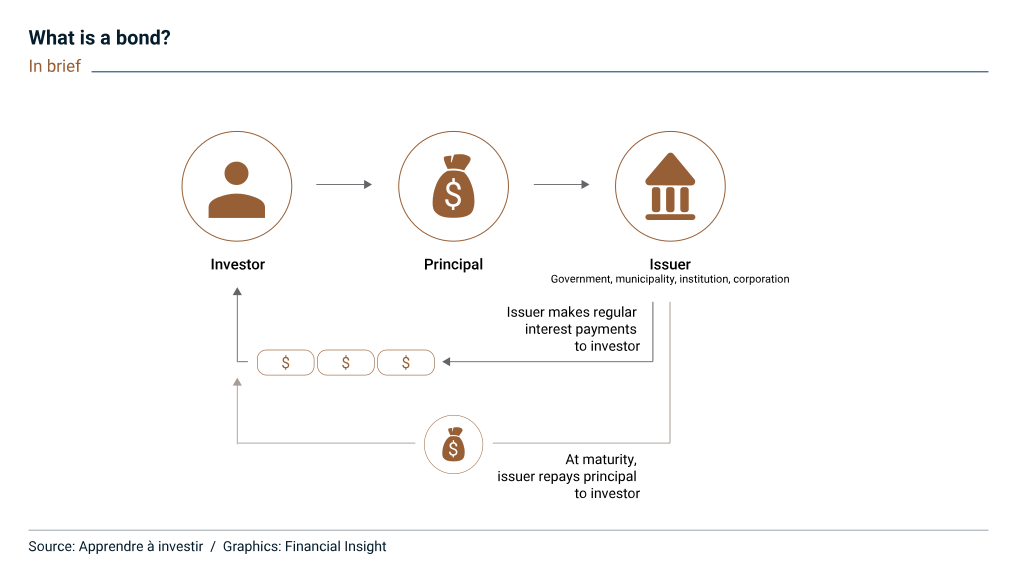
A bond is essentially a loan from an investor to a government, public institution or corporation. In return for this loan, the borrower issues a debt security – the bond – that represents a commitment to make regular interest payments and to repay the initial investment on a set maturity date
Because it’s a loan, a bond is a debt security. And because it provides regular interest payments, it is also known as a “fixed income security.”
A bond is different from a share
So a bond is very different from a share (or stock), which is an “equity security”: when you buy shares of a company, you become a part owner of that company. The company’s only commitment is to allow you to share in the gains if its value grows (which means that you could also experience losses). Some companies also pay dividends, but these are not guaranteed.
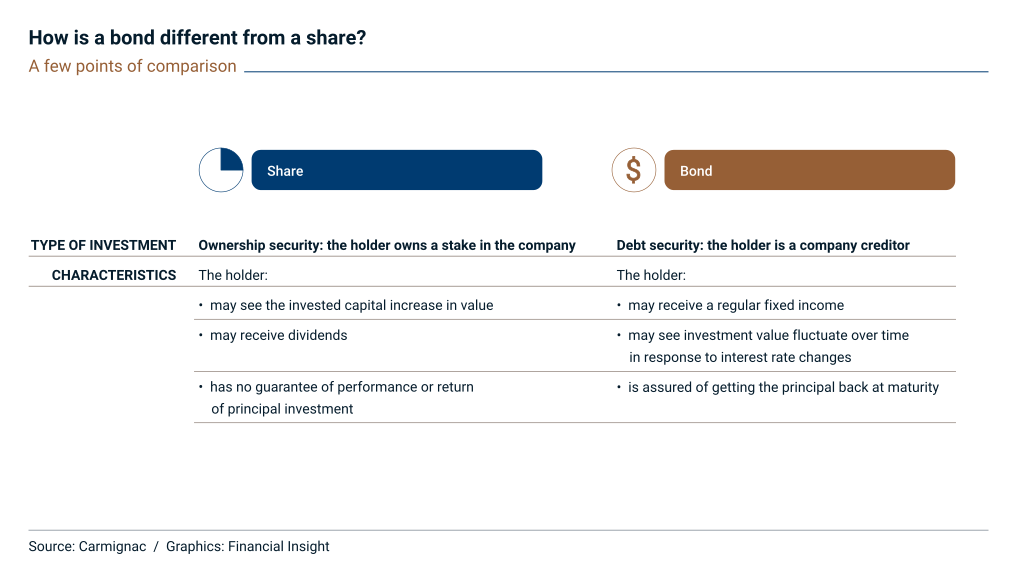
For all these reasons, bonds are considered to be a lower-risk investment than stocks; on the other hand, the potential returns are also lower. However, it’s important to realize that, even though repayment of the principal at maturity is guaranteed, the value of a bond may still fluctuate over time.
How is that possible?
How bond values fluctuate before maturity
The reason is that once a bond has been issued, it can be bought and sold by investors on the financial markets.
As with everything that can be traded, bonds are subject to the law of supply and demand.
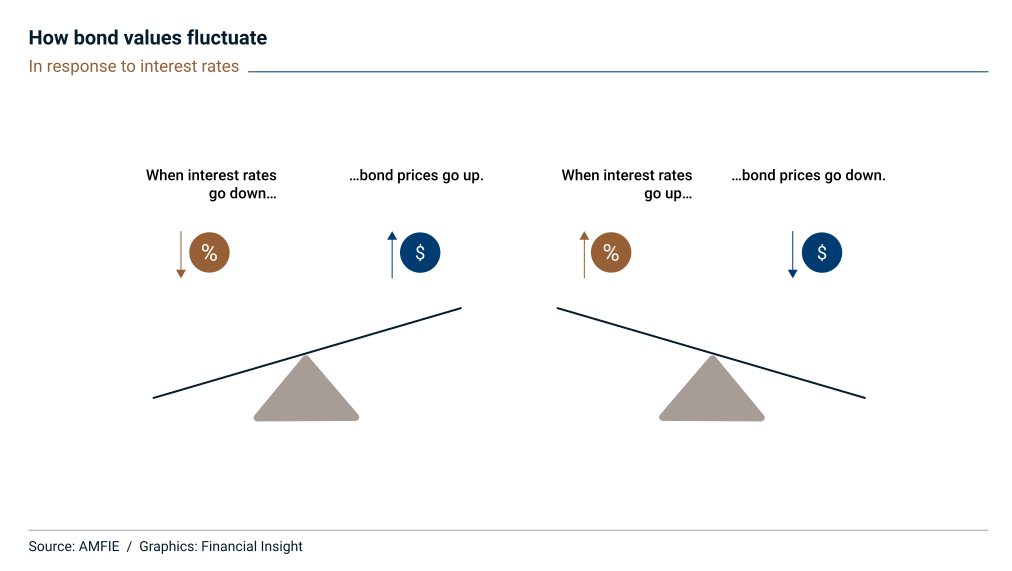
Let’s say that an investor holds a $10,000 bond with an interest rate of 4.00%. If equivalent bonds issued more recently are only paying 2.00%, a bond that pays twice the rate becomes very attractive: other investorswould be willing to pay more than $10,000 for it to improve their potential yield. On the other hand, if interest rates go up, the bond becomes less attractive and holders wishing to sell would have to accept less than what they paid for it.
That is the fundamental rule of the bond market: the value of outstanding bonds generally tends to rise as interest rates fall, and fall as interest rates rise.
A broad and complex market
The bond market is a major component of the financial markets. On a global scale, its capitalization outstrips that of the stock market, notably due to governments’ massive use of debt financing.
It is a complex market used primarily by large institutional investors such as pension plans. These investors work to optimize the performance of their portfolios by buying and selling securities based on their reading of what will happen to interest rates in the short, medium and long term. They also keep track of numerous other factors, such as yield spreads, i.e., the difference between the rates offered by issuers considered to be safe and the higher rates offered by issuers with a higher risk profile.
For the retail investor
Retail investors aren’t usually directly active on the bond market, but participate through mutual funds that are invested in bonds. For a minimal outlay, these funds provide a diversified, professionally managed bond portfolio, or even a portfolio pegged to a benchmark bond index. Without excluding the possibility of temporary ups and downs in response to interest rate movements, such funds offer the potential for a performance outlook consistent with the goal of long-term wealth preservation.
Your advisor can give you more information about this topic and help you to incorporate this asset class into your portfolio in a way that reflects your specific goals.
The following sources were used to prepare this article:
AMF, “Investir dans les obligations.”
AMFIE, “Understanding non-complex bonds.”
Carmignac, “Demystifying bonds in a matter of minutes.”
CFI, “Bonds”; “Active Bond Portfolio Management.”
Get Smarter About Money, “How bonds work.”
Investopedia, “Yield Spread: Definition, How It Works, and Types of Spreads.”
POSB, “101 of investing in Bonds.”
PUPrime, “What Are Bonds And How Do They Work.”