We have chosen for you. It’s not the right location? You can change it anytime.



Exchange-traded funds: getting to know this investment family
Are you hearing more and more talk about “exchange-traded funds” and wondering how these are different from mutual funds*? Here are the basics about this type of investment.
October 26th, 2026
Exchange-traded funds, often called “ETFs”, are playing an increasingly important role in Canadians’ investment portfolios. But behind the name and the acronym is a family of investments that is more diversified than you might expect.
Funds that are traded like shares
Like a mutual fund, an ETF pools the money from a large number of investors to build a portfolio of securities: equities, bonds, money market instruments or other assets.
The main difference between the two pertains to the way units are bought and sold. Mutual fund units are usually bought from or sold back to the fund itself at a price calculated at the end of each day based on the fund’s asset value. ETF units, on the other hand, are listed on the stock market and can be bought and sold during trading hours, just like the shares of a company. Based on these transactions, the ETF unit price rises and falls during each trading session, while generally remaining close to the value of the securities held by the fund.
A burgeoning market
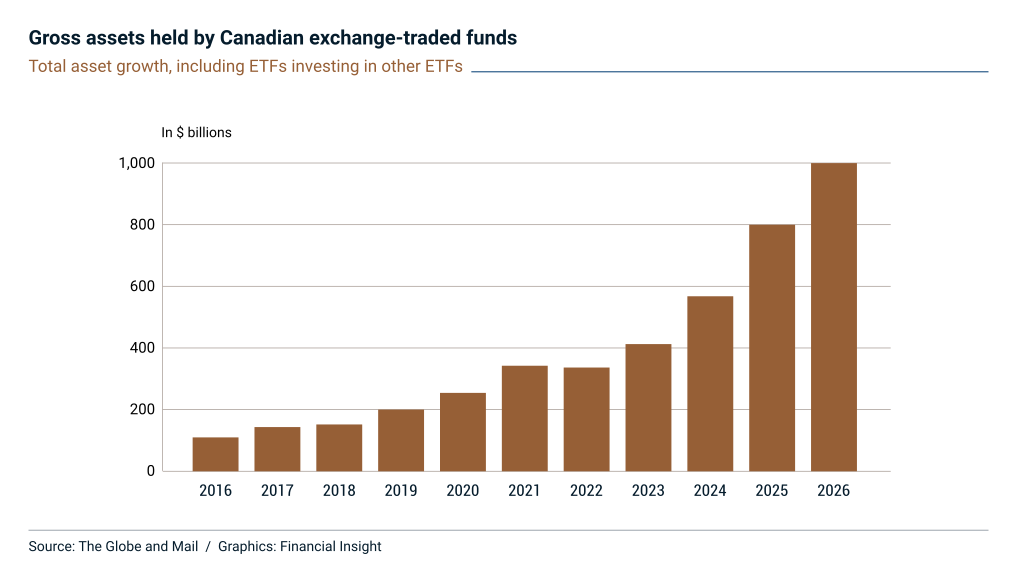
The first ETF in Canada – and the world – was launched in 1990. Since then, the number has soared: there are now about 2,000 different ETFs in Canada alone. Canadian ETFs (including those that hold other ETFs) had a total of about $1,000 billion in assets under management in mid-2026, compared with only about $100 billion ten years ago. This increase seems to stem from investors’ growing appetite for these investment vehicles.
Many ways to use ETFs
Like mutual funds, ETFs can be divided into categories that satisfy different needs. Here are the three main ones.
Index ETFs
Index ETFs are considered to be “passively managed” investments. When selecting securities, the manager is not looking to outperform the market: instead, the idea is to reproduce, as accurately as possible, the composition and performance of an index, for example a Canadian stock market index, a global equity index or a bond index.
This approach prioritizes portfolio diversification, providing exposure to many different securities with a single transaction, assuming that the index itself is diversified, of course (for more information about stock market indices, read this article). Furthermore, given the rules-based investment process, management fees are normally lower than for active management. And the return on the ETF will generally approximate the return on the underlying index, after deducting fees and taking certain variables into account.
Actively managed ETFs
An ETF can also be actively managed. In this case, a management team selects securities, adjusts their weighting and may make changes to the portfolio based on their market analysis. The goal may be to outperform a benchmark index, generate income, reduce volatility or apply a specific strategy.
This expertise and hands-on management typically command higher management fees than those for index ETFs. And, as for any actively managed fund, the choice between one fund or another should be based on an analysis of the fund strategy and the manager’s experience, along with the fees, risks and performance consistency.
ETF portfolios
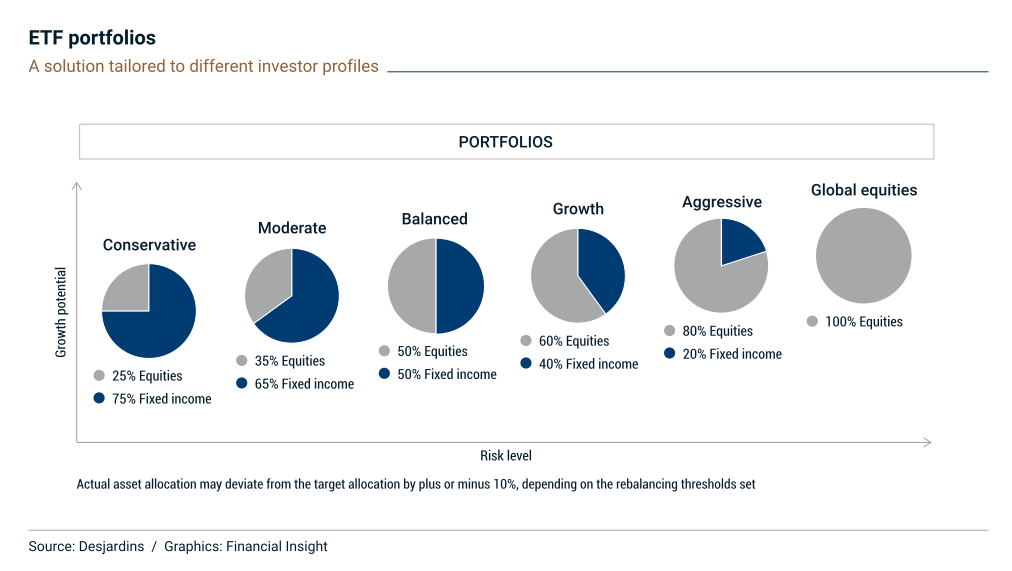
Finally, there are mutual funds and exchange-traded funds where the underlying assets are primarily… ETFs – usually index ETFs. The managers of these portfolios establish an asset allocation for equities, fixed income securities, and various markets, choose ETFs accordingly, and monitor asset values in order to rebalance the portfolio from time to time. As we can see in the following examples, an investor can thus purchase a single solution appropriate for his or her risk profile without having to buy several individual ETFs.
Looking beyond the acronym
As we can see, the “ETF” label basically describes an investment structure and an approach to trading that apply to a large number of very different products. Some ETFs follow broad markets; others concentrate on a single sector, region or specialized approach.
So, an evaluation of any fund’s assets, fees, liquidity, risk level and investment horizon, as well as how the ETF will fit into your overall portfolio, is recommended before you invest. Each approach could have a place within your strategy, depending on your investor profile, risk tolerance and financial goals.
Your advisor can help you decide which could give you the best fit.
* Mutual funds are distributed through SFL Wealth Management, a trade name used by Worldsource Wealth Management Inc., part of the Desjardins Group.
The following sources were used to prepare this article:
Autorité des marchés financiers, “Exchange-Traded Funds (ETFs)”; “Mutual Funds.”
Canadian ETF Association, “Canadian ETF Assets and Flows ».
Desjardins, “Desjardins ETFs.”
Desjardins Online Brokerage, “What are ETFs?”
Investment Executive, “Canadian ETF flows surpassed the $100B asset mark in first half of 2026.”
Canadian Investment Regulatory Organization, “Types of Investments and Types of Accounts.”
The Globe and Mail, “How Canada hit $1-trillion in gross ETF assets.”
TMX, “Toronto Stock Exchange celebrates 35 years of ETF innovation.”