We have chosen for you. It’s not the right location? You can change it anytime.



Do you need critical illness insurance…
…if you’re already covered by your employer’s group insurance plan?
October 26th, 2026
Many companies offer employees a benefit package that provides various types of insurance coverage. This might include being reimbursed for certain medical and dental care, for example, along with disability and critical illness benefits. But is this coverage sufficient to handle the financial consequences of a serious diagnosis?
Answer: Maybe; maybe not. Here’s why.
An important distinction
Two main types of insurance are designed to provide financial protection in the event of serious health problems: disability (or wage-loss) insurance and critical illness insurance. While these are often lumped together, they are not designed to cover the same situation.
Disability insurance usually pays a monthly benefit to replace a portion of your income if your health condition prevents you from working. It usually takes effect – after a waiting period – when the inability to work is recognized under the terms of an employment contract, and ends when the terms are no longer met or after a period specified in the contract. Critical illness insurance, on the other hand, provides for the payment of a lump sum if you are diagnosed with a covered illness or condition and the terms of the policy are met. This payment can be used in any way you see fit. [For more information about these two kinds of insurance, see this infographic.]
These two types of coverage can complement each other: the lump sum paid out by critical illness insurance could be invaluable when dealing with the financial consequences of a health problem in cases where partial income replacement simply wouldn’t be enough.
Four details to check
If you are covered by an insurance program through your employer, it might be good to check whether it includes critical illness insurance. If it does, there are three other things it might also be good to check.
Insurance amount
Would the benefit amount – for example $10,000 or $25,000 – be enough to cover the decrease in family income not offset by disability benefits plus ongoing loan payments, travel for specialized care, home care, non-insured treatments, home modifications, assistance from a family caregiver, not to mention unforeseen expenses?
Scope of coverage
Does the insurance cover fewer illnesses or involve more limitations than a personal policy might offer? Be aware that when it comes to critical illness insurance, the diagnosis must comply not only with the name of the illness, but with the precise definition set out in the policy.
Continuation
Any employment-related coverage may end if you leave your employer or when you retire. Some group insurance policies offer a continuation or conversion option, but this is not universal and may include a waiting period. As well, buying a new personal insurance policy later in life could be more expensive, or may become problematic depending on your health status.
Complementary coverage
As shown in the following table, personal critical illness insurance usually allows you to choose a coverage amount and duration tailored to your situation. It can remain in force, independent of your employment, as long as the premiums are paid and the policy terms are met. Depending on the product, it may also cover more illnesses, allow for partial benefits for some conditions or offer support services, such as the option of getting a second medical opinion.
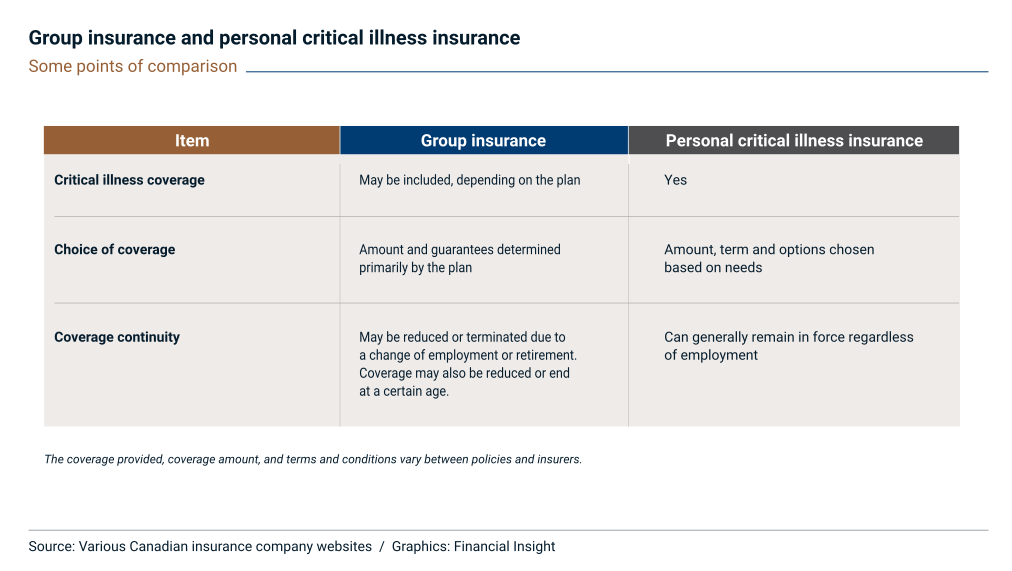
If you have group insurance and personal insurance, a single illness could entitle you to benefits from each policy, as long as the associated definitions and requirements have been satisfied.
Business owners: a special case
If you are a business owner, it might be even more important to assess the amount of coverage provided by your group insurance plan, if you have one. In the event of a critical illness diagnosis, appropriate coverage can help preserve your financial security as well as your company’s business continuity during this time of transition.
In the hands of the company, critical illness insurance could free up some cash to hire your replacement, pay overhead expenses, make loan payments or honour current contracts. A critical illness policy could also be integrated with certain shareholder agreements to help finance a possible share buyback following a covered diagnosis.
Assessing your needs
Whether you are an employee or a business owner, if you are fortunate enough to have group critical illness insurance you are already benefitting from significant coverage. A personal insurance policy could be a natural complement if the amount, scope or duration of the group policy does not fully meet your needs.
Your advisor will be able to help you compare your group and personal coverage and measure any gaps that could be filled.
The following sources were used to prepare this article:
Canadian Life & Health Insurance Association, “Canadian Life & Health Insurance Facts”; “A Guide to Critical Illness Insurance.”
Autorité des marchés financiers, “How to choose critical illness insurance.”
Desjardins Insurance, “Critical illness insurance”; “Disability insurance”; “Converting group insurance to individual”; “Critical illness insurance for business owners.”
EBSource, “Group Critical Illness Insurance vs Individual Policy: A Detailed Comparison for Canadians”; “Group critical illness insurance in Canada: coverage, tax treatment, and coordination.”
PolicyAdvisor, “A comprehensive guide to understanding group critical illness insurance in Canada.”
Protégez-vous, “L’assurance maladies graves en 10 questions.”
SFL, “Disability insurance or critical illness insurance: how to decide?”