We have chosen for you. It’s not the right location? You can change it anytime.



Beyond the policy interest rate
Or: How financial markets set interest rates for your loans and investments.
September 21st, 2026
Since the end of October 2025, the Bank of Canada has held its policy interest rate steady at 2.25%. Even so, if you have shopped around for a guaranteed investment certificate (GIC) or renewed a mortgage during this time, you may have noticed that there has been some movement in the rates offered – and sometimes they’ve gone up. How does that work?
The answer lies in a fact that people tend to forget: the policy interest rate is only one of many threads woven into the fabric of interest rates. To understand the others, we need to get acquainted with the bond market.
The policy interest rate: a signal
The policy interest rate is the target set by the Bank of Canada for the rate at which financial institutions lend each other money for one day (overnight rate). It serves as a reference point for short-term products, especially lines of credit and variable-rate mortgages. When the Bank raises or lowers the policy interest rate, it is sending a signal about the direction of its monetary policy. But for longer term products – a five-year fixed rate mortgage or a three-year GIC, for instance – this signal is just the starting point.
The bond market: a barometer for longer term rates
To set medium- and long-term rates, financial institutions look primarily at the bond market. With billions of dollars in government and corporate bonds being traded every day, the bond market offers a real-time glimpse at what investors are thinking about the economic future.
Yields on government bonds with comparable maturities serve as benchmarks. For example, when an investor buys a Government of Canada bond with a certain maturity, that investor is accepting a fixed yield for that length of time. If the markets expect inflation to surge in the next few years, they will demand a higher return to offset the loss in purchasing power. As a result, bond yields will increase – and so will the rates for fixed mortgages and long-term GICs.
It’s precisely this phenomenon that accounts for a situation that may seem paradoxical: the policy interest rate can remain steady while some GIC rates increase in response to changing bond yields and financing terms.
The forces at play
A number of factors will heat up – or cool down – bond yields, and thus the credit market as a whole.
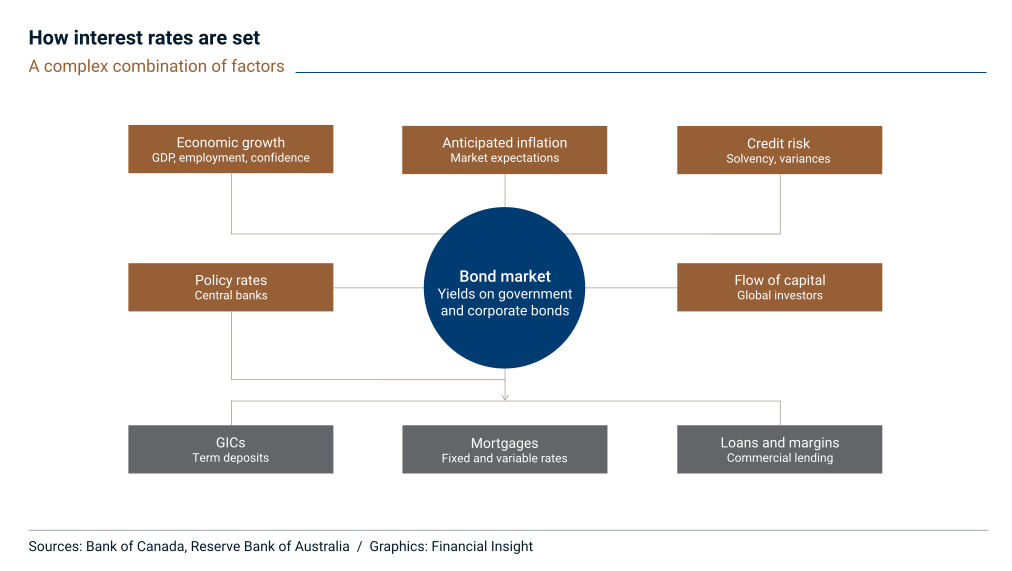
Anticipated inflation is the most influential factor when it comes to long-term rates. Even if the Bank of Canada doesn’t move, when economic data seem to indicate that inflation will persist, bonds will react with higher yields.
Economic growth also plays a role. Strong growth can push yields higher, especially if it is fuelling inflation or convincing the markets that the policy rate will remain high for longer. On the other hand, the prospect of an economic slowdown may lead to a drop in bond yields.
Credit risk primarily influences the yield required on bonds from corporations and other issuers. A borrower considered to be a higher risk will generally have to offer a higher return. As well, GIC rates depend on each institution’s financing needs and commercial strategy, which explains why these rates may vary from one institution to another.
Lastly, the global flow of capital also comes into play. In an interconnected financial world, Canadian rates react to what happens in the U.S., European and Asian markets. If yields in the United States increase significantly, some investors may show a preference for U.S. bonds. This might cause a drop in demand and prices for Canadian bonds, pushing their yields higher.
What this means for you
Understanding these dynamics changes how financial decisions should be approached. When you’re planning to invest or borrow, monitoring bond trends – and not just Bank of Canada announcements – can provide a better understanding of the rates offered and help you compare products and maturities based on your needs.
After all, along with your own credit terms, these factors will play a significant role in determining the return on your GIC or how much your next mortgage will cost.
The following sources were used to prepare this article:
Financial Consumer Agency of Canada, “Module 5: Saving and investing.”
Autorité des marchés financiers (AMF), “Inflation and its impacts on your finances”; “Debt securities.”
Bank of Canada, “Understanding our policy interest rate”; “Monetary policy”; “Selected bond yields.”
Canadian Mortgage Trends, “Bond yields.”
nesto.ca, “5 Year Government of Canada Bond Yield Explained.”
Reserve Bank of Australia, “Bonds and the Yield Curve.”