We have chosen for you. It’s not the right location? You can change it anytime.


The 2026 federal budget in 10 highlights
A recap of key measures to be aware of in the budget tabled on November 5, 2026.
November 6th, 2026
Canada’s Finance Minister, François-Philippe Champagne, addressed the House of Commons on the afternoon of November 5 to table his second budget. At the same time, hundreds of pages of documentation were made public, detailing the measures it contains. Here is a brief overview of what this latest budget has to offer, especially from the perspective of personal finances for Canadian taxpayers.
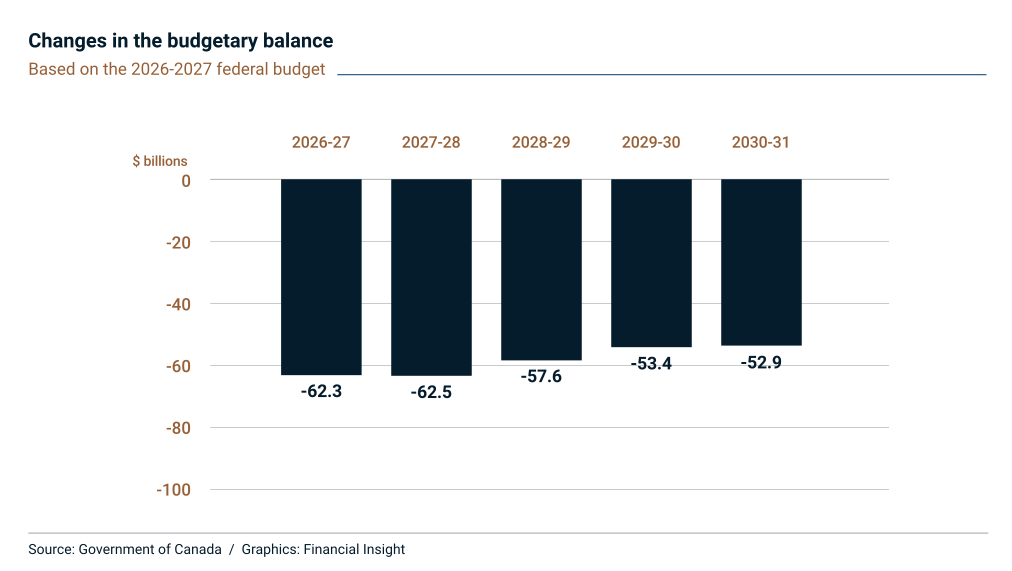
No balanced budget, but smaller deficits
Let’s deal with the deficit first: the budget is not expected to be balanced within the next five years. Nonetheless, the figures released this year paint a more optimistic picture than those in the 2025 budget. The deficit for this year (2026-2027) is now projected to be $62.3 billion, or about three billion less than initially expected. The budgetary balances for subsequent years are also slightly less negative than anticipated. Accordingly, the debt to gross domestic product (GDP) ratio should drop from 1.8% in 2026-2027 to 1.3% in 2030-2031.
A budget that carries on
Finance Minister Champagne’s budget continues along the path set by the previous one, and seeks to stimulate investment and economic growth. In particular, it confirms the implementation of the Productivity Mega Deduction announced earlier this year, which will allow companies to deduct the full cost of eligible new investments. According to the government, this mega deduction will help to reduce Canada’s marginal effective tax rate on new investments to as little as 6.4%, the lowest of any G7 country.
However, this year’s budget also contains a series of measures more directly associated with personal finance and tax concerns. Many, in particular, are intended to simplify the tax system for individuals.
An RRSP-for-life?
The government has announced its intention to merge the tax rules applying to RRSPs and RRIFs, the registered retirement income funds into which RRSPs must usually be converted before the end of the year in which the account holder turns 71. This change would open the door to an “RRSP-for-life” that would never have to be converted. Minimum withdrawals after age 71 would still be required, however. The government is planning to consult the public about this proposal between now and January 8, 2027.
Income tax filing deadline: May 15
The government also proposes to simplify the tax filing calendar for individuals. Currently, individual taxpayers have to file their returns and pay any balance owing no later than April 30. Self-employed workers and their spouses also have to pay any balance owing by April 30, but they have more time – until June 15 – to file their returns. Starting with the 2027 tax year, i.e., in the spring of 2028, these two deadlines would be changed to May 15 for all individuals.Changes to your tax instalment payments
Many people have to pay their taxes by making instalment payments every three months if part or all of their income is not subject to at-source deductions. If this is your case, you could be interested in another proposed change. At present, instalments may be required if the net tax owing is more than $3,000 ($1,800 for federal tax in Quebec) for the current year and at least one of the two prior years. The government is proposing to raise this threshold to $7,500 ($4,500 in Quebec). As well, self-employed individuals with business income could also be allowed to make a single annual instalment payment instead of quarterly payments. Effective date: the 2028 tax year.
Simplified deductions
In another effort to simplify the tax system for individuals, the government has announced that, starting in 2027, thousands of taxpayers will be able to claim optional flat amounts for some eligible expenses, without needing to save all their receipts or itemize their expenses. For example, someone who moved for work or school could choose to deduct a flat amount of $1,000; people doing renovations eligible for the home accessibility tax credit could also decide to claim a single flat amount of $1,000. Moreover, as of tax year 2026, people suffering from celiac disease will be able to claim $1,000 without supporting receipts to cover the additional cost of gluten-free foods. This simplified procedure will also apply to other situations.
New incentives for SMBs
If you own a small or medium-sized business, this news is for you: through the Canadian Growth Incentive, the government is introducing a new tax exemption on up to $15 million in capital gains generated by the sale of a successful eligible investment. As well, it plans to allow increased deferral of taxes on capital gains when the proceeds are reinvested in another Canadian small business. The aim: to allow business builders to keep more of the benefits, and encourage more capital to flow to Canadian businesses.A new helping hand for families
Budget 2026 proposes to enhance the Canada Groceries and Essentials Benefit with a one-time 50% increase delivered in early 2027. This supplement, intended for taxpayers with modest incomes, could provide $339 for a single person without children and $679 for a couple with two children. According to the government, this would bring total support for eligible households in 2026-2027 to $1,290 for a single person without children and $2,570 for a couple with two children.
Enhanced tax credit for caregivers
The government proposes to make the Canada Caregiver Credit fully refundable. This means that an individual could receive it even if his or her income is below the tax threshold. This change would specifically benefit those who give up their sources of income, either fully or partially, in order to care for a loved one. The government estimates that 180,000 taxpayers who currently do not gain any benefit from the credit will now receive support. The credit could amount to $1,260 annually in 2027 and would subsequently be indexed.
On the environmental front
The Champagne budget has also confirmed certain programs to do with the environment. To begin with, there’s the National Heat Pump Rebate Program, which provides financial support for the purchase of a heat pump. This will involve a total investment of $2 billion over eight years. The government is also planning to invest $587 million over five years for the installation of over 55,000 electric vehicle charging stations in areas with the greatest need for infrastructure.
In closing, one final note: if you were among the many families who took advantage of free admission to certain museums and Parks Canada sites in 2026, you can look forward to doing it again in the summer of 2027, because the government is planning to renew the Canada Strong pass. Free admission to Canada’s national museums will also be made permanent for young people under the age of 25.
Obviously, this overview covers only a few of the measures contained in the 2026 federal budget. Many others have been announced, notably an extensive $11.2 billion program to tackle homelessness. For detailed information about all the measures, visit the official federal budget 2026 website. As well, feel free to contact your advisor, who can help you assess any future repercussions that these measures might have on your own financial situation.
The following sources were used to prepare this article:
Conseiller.ca, “Ottawa veut simplifier le régime fiscal des particuliers.”
Finance et investissement, “Ottawa veut alléger les formalités fiscales.”
Government of Canada, “Budget 2026.”
Investment Executive, “Budget proposes ‘RRSP for life,’ eliminating need to convert to RRIF.”
La Presse, “Ce qui bouge dans votre portefeuille.”
Radio-Canada, “Budget fédéral 2026.”
The Globe and Mail, “Budget 2026 highlights, from housing to business tax relief.”