We have chosen for you. It’s not the right location? You can change it anytime.



Responsible investment: gaining in popularity
Would you like your investments to reflect your core values? You’re not alone: a growing number of investors believe that this is important.
June 11th, 2026
Recent news might give the impression that interest in the approach known as “responsible” or “sustainable” investing is ebbing, especially when it comes to the environment. In reality, recent data would seem to indicate nothing of the kind.
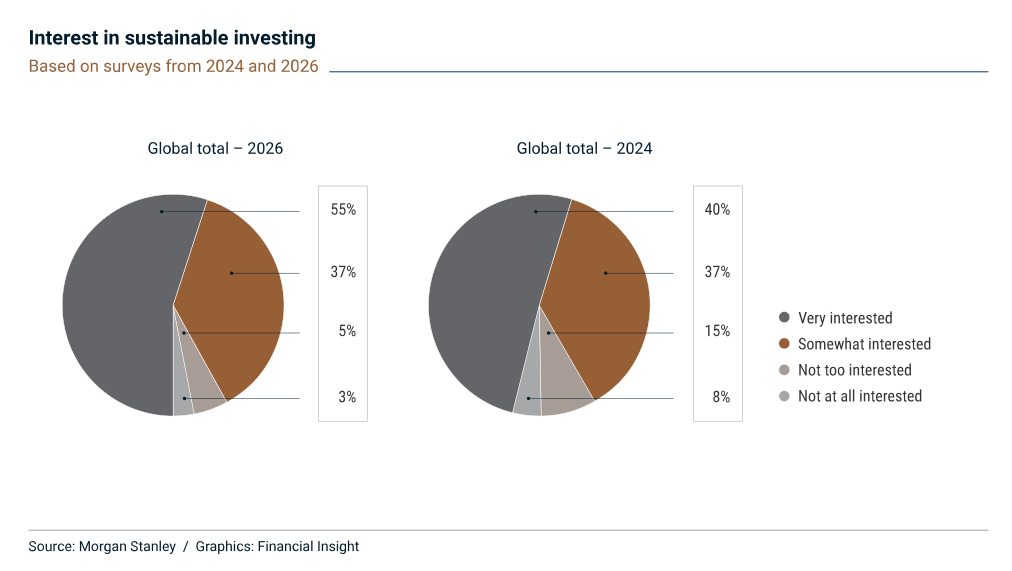
A global survey by the firm Morgan Stanley, for example, indicates that in the past two years, the percentage of investors who report being very interested in sustainable investment rose by 15% – while the percentage of those not too or not at all interested fell by the same amount.
Closer to home, a recent survey by the Responsible Investment Association found that 67% of Canadian investors are interested in responsible investment. Among those who already have holdings in this category, nearly half expect to increase their RI asset allocations. Moreover, a majority of professional investment managers – 75% – state that they make responsible investment a priority.
If you would like to bring certain personal values to bear on your investing, it is highly likely that your advisor will be able to recommend a number of financial vehicles aligned with these values.
A few important details
But what, exactly, do we mean by “responsible investment”? In simple terms, it’s an investment approach where decision-making integrates environmental, social and governance factors, often referred to by the acronym “ESG”.
For instance, environmental criteria might include management of greenhouse gas emissions, sustainable use of natural resources or energy-related policies. Social factors involve such issues as labour relations, diversity, employee health and safety, as well as community relations. Lastly, governance criteria relate to how the company is administered, including composition of the board of directors, business ethics and transparency.
How to get started
A variety of solutions can be considered by individual investors who would like to apply this approach to all or part of their portfolio. Mutual funds* with a responsible investment slant are among the most accessible options because they allow investors to build an ESG portfolio that is diversified among several markets, sectors and businesses, while taking their personal investment strategies into account.
Depending on the product, recommended strategies might:
exclude certain sectors, activities or companies (for example, the tobacco industry, the military sector or businesses active in fossil fuel extraction)
give preference to companies demonstrating best practices in ESG (for example, a company known to promote diversity in its recruitment process)
invest in specific themes, such as renewable energy or clean tech
exert influence on companies through shareholder voting and discussions with management.
Note that the specific ESG criteria factored into decision-making may vary depending on the manager and the fund. As well, above and beyond the responsible investment approach, it is important to stress that any decision to invest in this type of vehicle should, like any other investment decision, take into account your financial situation, your financial objectives, your risk tolerance and your investment horizon.
Does it pay?
Is it reasonable to fear that a responsible investment approach might involve a trade-off in terms of lower potential returns than other investments?
In fact, some major indices that track responsible investments, such as the Dow Jones Sustainability Index or the MSCI ESG indices, have posted returns over long periods that are comparable to the performance of the major traditional stock indices. However, as with any investment, performance may vary depending on the period, markets, preferred sectors and stock-picking criteria used.
Like any other investment strategy, some “responsible” strategies may go through periods of relatively lower performance, especially if they limit exposure to certain economic sectors that are showing strong short-term growth. Over the longer term, however, many financial analysts believe that when companies are well-positioned in terms of environmental, social and governance factors, not only could they offer attractive returns, but they will also be better prepared to face some future risks and economic developments, especially when it comes to the energy transition.
It appears that responsible investment doesn’t have to mean compromising on performance in order to honour your personal beliefs. Instead, it offers a way of integrating environmental, social or governance concerns into a comprehensive investment strategy focused not only on upholding specific values, but also on managing risks and returns.
If this approach appeals to you, your advisor can help you gain some insight into the various options available and determine how they might fit into your portfolio.
* Mutual funds are offered through mutual fund representatives affiliated with SFL Wealth Management, a trade name used by Worldsource Wealth Management Inc., an entity of Desjardins Group. As with any investment, responsible investment funds involve risks and their performance may vary depending on the markets and periods observed. Past performance is not a guarantee of future performance.
The following sources were used to prepare this article:
Amundi Research Investment, “Responsible Investment Views 2026.”
Autorité des marchés financiers, “Defining responsible or sustainable investing.”
Autorité des marchés financiers (France), “Quelles stratégies d'investissement se cachent derrière l'ISR?”
Desjardins, “Responsible investing.”
DNV, “ESG risks: definition and risk management strategies.”
Fonds Desjardins, “2025 Annual Report on Responsible Investment.”
Investment Executive, “Canadian asset managers, investors embracing responsible investing: report.”
MSCI, “SRI Indexes.”
Morgan Stanley, “Sustainable Signals,” 2024 and 2026.
Portfolio Management Research, “Socially Responsible Indexes.”
PR Newswire, “Responsible Investment Allocations Set to Rise as Canadian Investor Preferences Shift.”
Responsible Investment Association, “2025 Canadian RI Trends Report.”