We have chosen for you. It’s not the right location? You can change it anytime.



How is Quebec doing financially?
Discover the highlights of the budget tabled in Quebec’s National Assembly on March 18, 2026, by Finance Minister Éric Girard.
March 19th, 2026
For his final budget before next fall’s elections, Quebec’s Finance Minister, Éric Girard, promised a “sensible, targeted and responsible” approach, while offering glimpses of encouraging news about the provincial budget deficit. What did he mean by that?
Here are the key takeaways from a personal finance perspective.
Lower-than-expected deficits – including for the past year
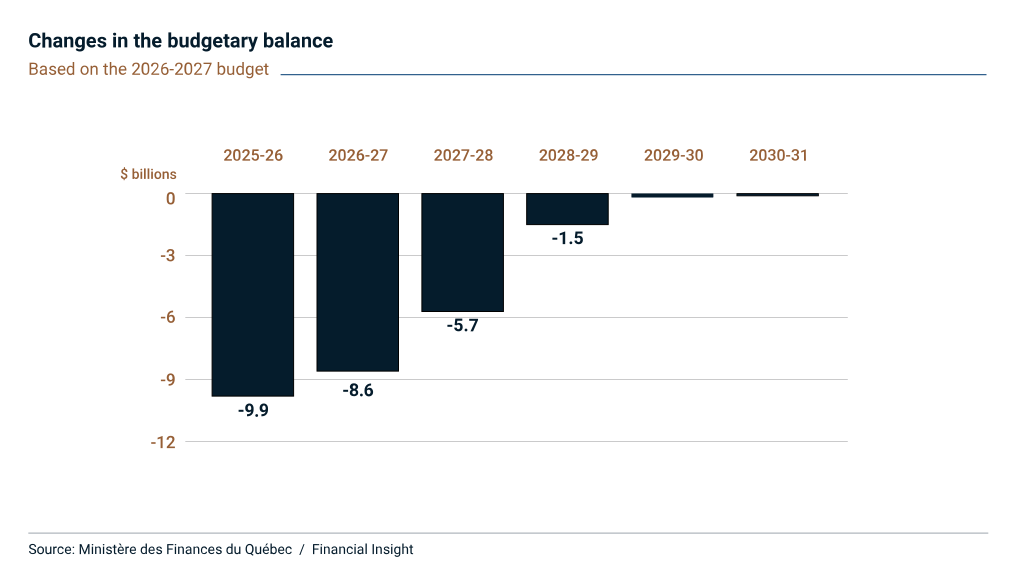
First of all, the deficit projections in the budget tabled last year, in March 2025, have been substantially revised. While the Minister predicted a deficit of $13.6 billion for fiscal 2025-2026, it appears that it will only be $9.9 billion when this fiscal year ends on March 31. The same goes for next year: initially estimated at $9.5 billion, the deficit is now projected to be $8.6 billion. This more favourable budgetary outlook enables the Minister to maintain his goal of balancing the budget by 2029-2030, despite an economic climate he terms uncertain due to the renegotiation of the Canada-United States-Mexico Agreement (CUSMA), among other things.
- 5,000 childcare spaces converted to subsidized spaces
Among the measures likely to have an impact on Quebec taxpayers’ finances, one of the most noteworthy – especially if you have young children – involves the network of educational childcare services. The government is setting aside $396.5 million to convert 5,000 non-subsidized childcare spaces into subsidized spaces, starting in 2026-2027. In the context of this program expansion, priority will be given to the regions with the greatest needs. - Assistance for renovations and construction
Are you a homeowner and planning to have some work done to upgrade your home? The Rénoclimat program is getting a new component, called Rénoclimat – Adaptation, to provide financial support to owners needing renovations to make their homes more resilient in the face of climate change. The focus, in particular, is on work to protect foundations or install check valves. Overall, this new component will provide $425 million over five years to support eligible owners. Note also that the LogisVert program, which provides financial assistance to install heat pumps or energy-efficient household appliances, will also be enhanced for the next four years.
Still in the housing sector, the government plans to spend $209 million over three years to promote the construction of some 1,000 affordable housing units throughout Quebec. - Maintaining the cap on school tax increases
Starting with the 2022 budget, the government has capped the average school tax increase at 3% for all regions of Quebec. This cap will be maintained for another year, which amounts to government funding of $449.8 million. - Measures to support Quebec’s economic transformation
Business owners will likely want to pay close attention to the sections of the budget dealing with Quebec’s economic transformation. In this respect, the government is planning initiatives totalling more than $1.7 billion over five years, including $693.1 million to help businesses adapt to the shifting economic landscape; $581.3 million to benefit SMBs in all regions; and $429.1 million to support the cultural sector. - Changes to the VRSP
Also of interest to business owners, the government plans to make certain changes to the voluntary retirement savings plan (VRSP) so that it will remain a low-cost retirement savings vehicle available to all Quebecers. Among other changes, there is a budget proposal to introduce a minimum contribution rate of 2% of salary. Details of the planned changes will be announced by Retraite Québec in the near future. - Support for culture
Among the measures targeting the cultural sector, a number may interest you if you have school-age children. Note, in particular, that funding for school outings will be maintained, as will the Culture in Schools program – two measures that allow students to experience art in all its many forms. - A helping hand for seniors…
The budget provides for extending the assistance program for private seniors’ residences (RPAs) in 2026. This program helps limit the impact of insurance premium increases on the cost of rent in RPAs, private CHSLDs, home support social economy enterprises, intermediate resources and private rehabilitation hospitals. - …and for caregivers
Finally, family caregivers may also want to take note of an envelope of $136 million over four years that has been announced to fund support services and assistance for those providing care for a family member. This represents an increase in assistance of about $34 million per year.
Clearly, as the Minister announced, this budget for 2026-2027 is indeed targeted on specific measures. However, it may contain details that could affect your personal plans and your financial situation. If the prospect of reading the full budget statement (available here) is unappealing, feel free to talk to your advisor, who can help you assess how this budget may affect your specific situation, as well as providing answers to any other finance-related questions you may have.
The following sources were used to prepare this article:
La Presse, “Qu’y a-t-il dans le budget pour les jeunes familles?.”
Le Devoir, “Le budget du Québec en un coup d’œil.”
Les affaires, “Que retenir du budget Girard 2026.”
Ministère des Finances du Québec, “Budget 2026-2027.”
Radio-Canada, “Budget du Québec : quelques bonnes nouvelles pour les contribuables.”