How do you see your investments?

How do you see your investments?

Unknown to us, our investment decisions are sometimes influenced by psychological biases that can have a detrimental effect on our long-term results. Find out what they are.

February 19th, 2026

It is sometimes said that the behaviour of financial markets is determined by two contradictory emotions: greed on one hand and fear on the other. In reality, behavioural psychology shows that a large number of subjective factors, or “psychological biases,” have a more subtle effect on investors’ perceptions, often leading them to make decisions that are against their best interests. 

Here are five biases to be aware of when watching your investments.
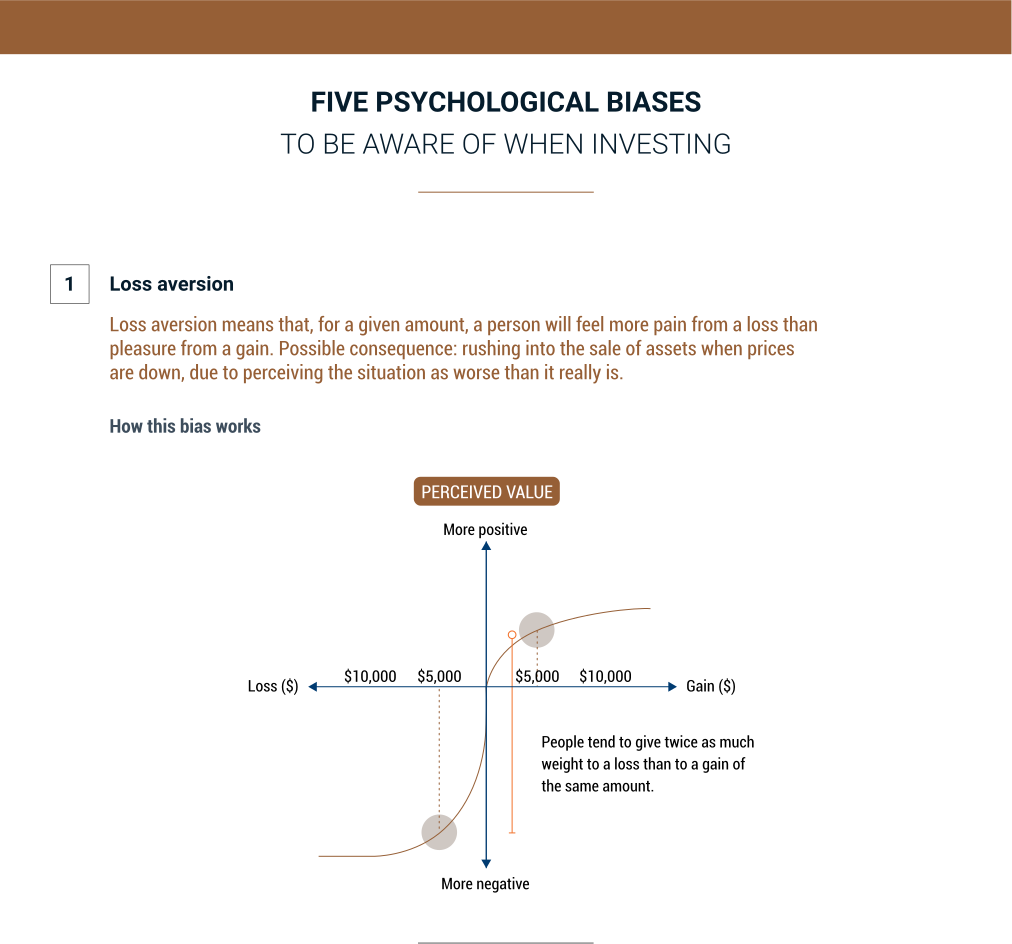
Infographic entitled “Five psychological biases to be aware of when investing.” The first section deals with loss aversion. A paragraph explains that, for a given amount, a person will feel more pain from a loss than pleasure from a gain, which can lead to rushed decisions to sell when the market declines.  A graph illustrates this bias. the horizontal axis represents gains and losses in dollars, with losses on the left (up to $10,000) and gains on the right (up to $10,000). The vertical axis indicated the perceived value, running from “more negative” at the bottom to “more positive” at the top. An asymmetrical curve shows that the slope is steeper on the loss side than the gain side: for a loss of $5,000, the perceived negative value is about twice as much as the perceived positive value associated with a $5,000 gain. A note specifies that people tend to give twice as much weight to a loss than to an equivalent gain.
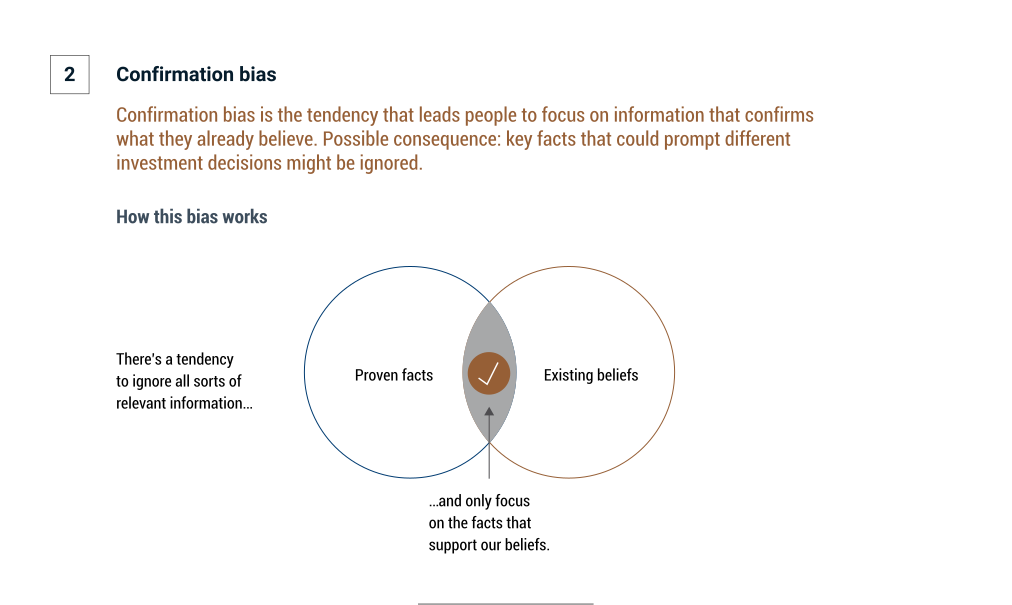
Infographic entitled “Confirmation bias.” A paragraph explains that this bias consists of focusing mainly on information that confirms our existing beliefs, which can lead us to ignore key facts that might prompt us to make different investment decisions.  A Venn diagram illustrates this mechanism. Two circles overlap: the left circle is labelled “Proven facts” and the right circle is labelled “Existing beliefs.” The area where the circles overlap, coloured grey, represents information that confirms the existing beliefs. A checkmark appears in the middle of this common area, indicating that is attracts attention. To the left of the diagram, a paragraph indicates that there is a tendency to ignore all sorts of relevant information. Underneath the diagram, an arrow pointing to the overlapping area specifies that people only focus on the information that reinforces existing beliefs.
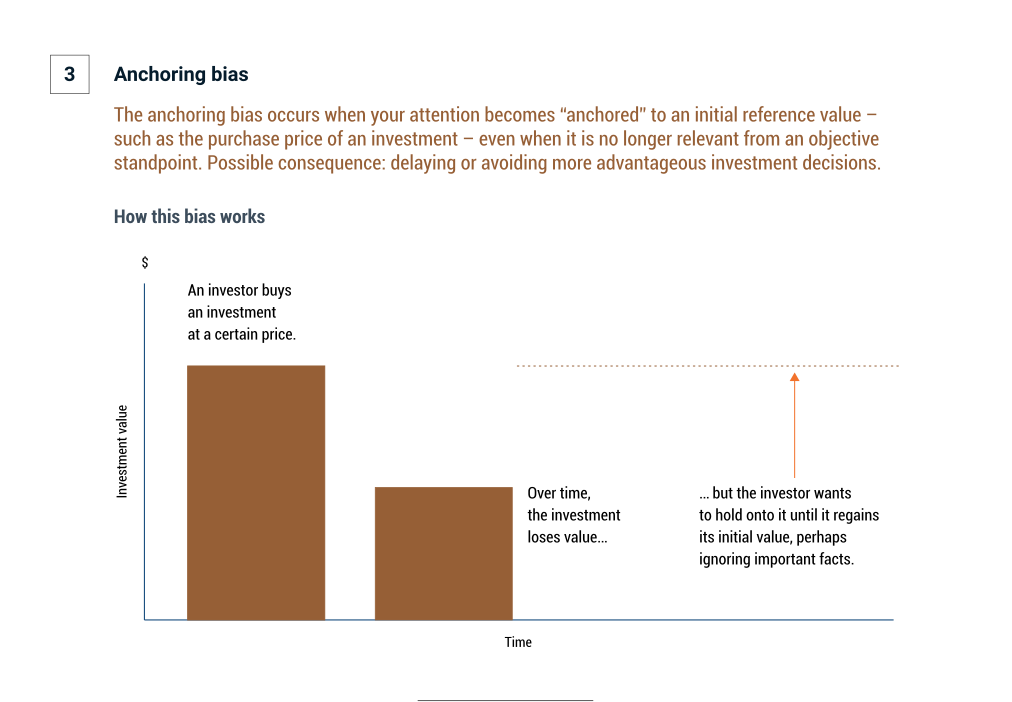
Infographic entitled “Anchoring bias.” A paragraph explains that this bias consists of remaining attached to an initial benchmark value, such as the purchase price of an investment, even when this value is no longer relevant, which may delay or prevent more advantageous investment decisions.  A bar graph illustrates this behaviour over time. The vertical axis represents the investment value in dollars and the horizontal axis represents time. On the left, the investor’s initial purchase price is represented by a bar. Farther along the time axis, a second, lower, bar shows that the investment has lost value. A horizontal dotted line corresponding to the initial value extends to the right. An arrow pointing to this line indicates that the investor wants to hold the investment until it regains the initial purchase price, even if this could result in ignoring other more relevant information or investment opportunities.
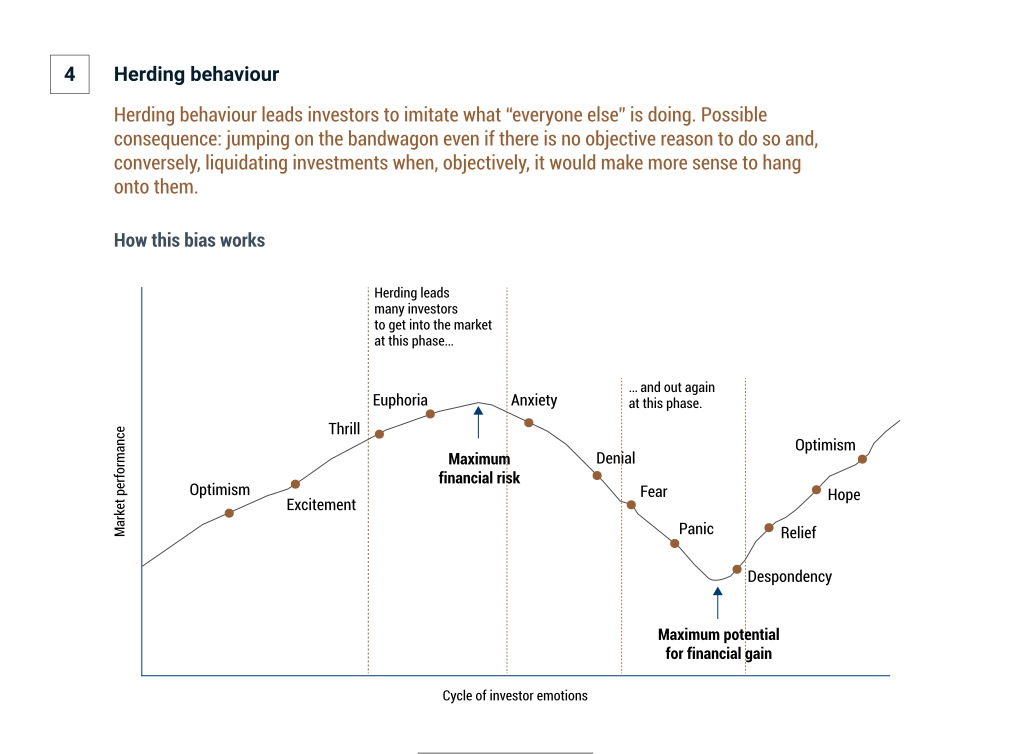
Infographic entitled “Herding behaviour.” A paragraph explains that this bias leads investors to imitate the behaviour of most other investors, which can result in investing at a bad time or, conversely, selling during phases when it would be better from an objective standpoint to hold onto investments.  A line graph illustrates the cycle of investor emotions in response to market behaviour. The vertical axis represents the market performance and the horizontal axis represents the cycle of emotions. A curve rises, then falls, showing the typical development of a market cycle.  During the rising phase, the emotions identified are optimism, excitement, thrill and euphoria. A note indicates that the herding effect pushes a large number of investors to get into the market at that time. At the peak of the curve, corresponding to euphoria, an arrow indicates “maximum financial risk.”  In the declining phase, the emotions go from anxiety, denial and fear to panic. A note specifies that herding behaviour convinces many investors to get out of the market.  At the lowest point of the curve, associated with despondency, an arrow indicates the “maximum potential for financial gain.” The next phase shows a gradual upswing marked by relief, hope and a return to optimism.
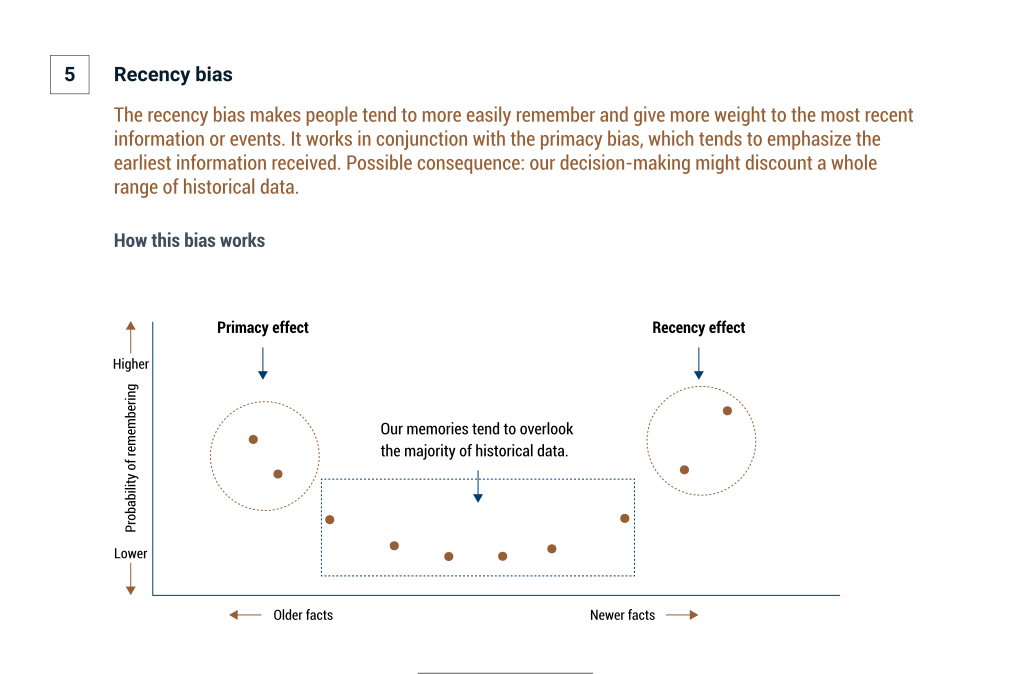
Infographic entitled “Recency bias.” A paragraph explains that this bias involves a tendency to give more weight to the most recent information or events, to the detriment of older information. It is presented as working in conjunction with the primacy bias, which tends to emphasize the earliest information received. This can lead people to ignore a whole range of historical data when making investment decisions   A graph illustrates how this bias works. The vertical axis represents the probability of remembering a fact, going from “Lower” at the bottom to “Higher” at the top. The horizontal axis represents the chronological order of information, with the oldest on the left and the most recent on the right.  On the left part of the graph, a circle marks the primacy effect, where some very old information has a high probability of being remembered. On the right, a similar circle marks the recency effect, showing that some recent facts also stick firmly in one’s memory.  Between these two circles, a central rectangular area contains a number of points representing historical data from the intervening time, accompanied by a note indicating that our memories tend to overlook the majority of historical data. As a whole, the diagram shows that our attention focuses on information that is very old or very new, to the detriment of the volume of data situated between these two extremes.
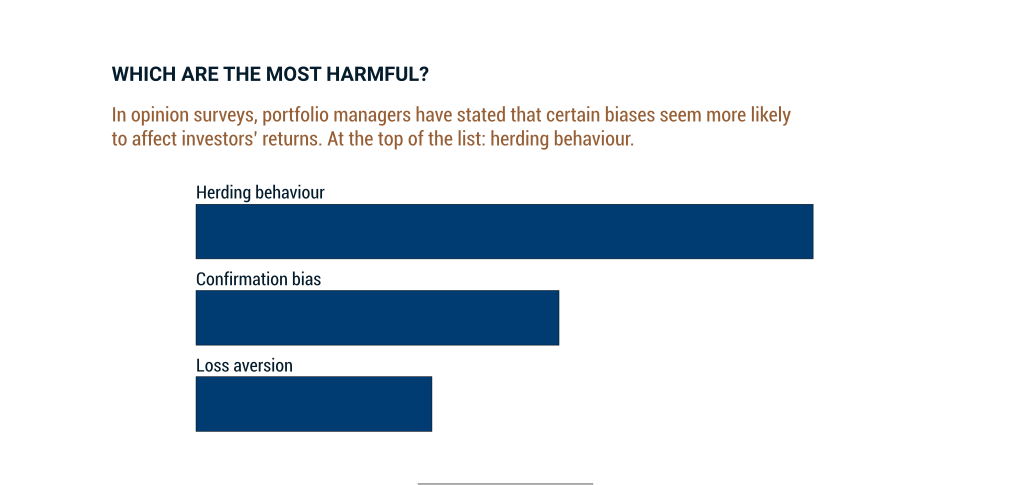
Infographic entitled “Which are the most harmful?”. An introductory paragraph states that surveys of portfolio managers show that some psychological biases have a larger impact than others on investors’ returns, with herding being identified as the most harmful.  A horizontal bar graph illustrates this ranking. Three biases are included. The longest bar corresponds to the herding effect, indicating that it has the highest perceived impact. A shorter bar represents confirmation bias, ranked second. The shortest bar corresponds to loss aversion, indicating a lower perceived impact than the other two. As a whole, the graph provides a visual representation of the herding effect as the bias considered to be most harmful by the managers in the survey.
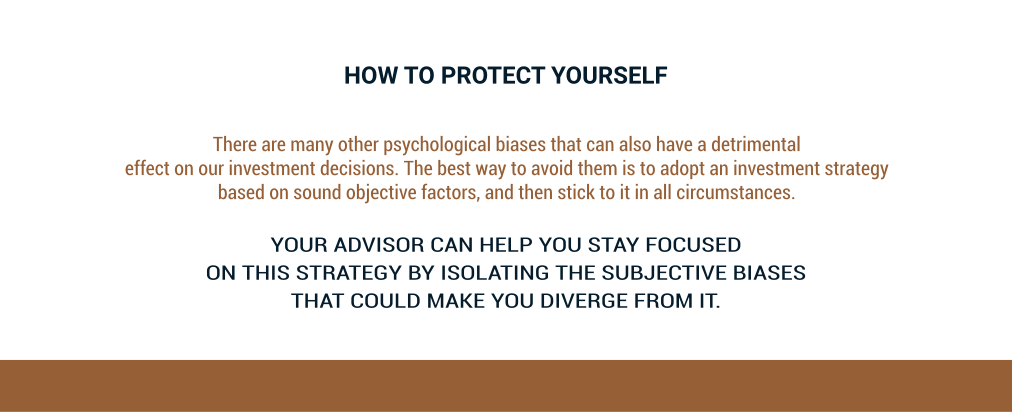
Concluding box entitled “How to protect yourself.” The paragraph explains that there are many psychological biases that can be detrimental to investment decisions and that the most effective way to avoid them is to set up an investment strategy based on sound objective factors, and then stick to it in all circumstances.  A central message, highlighted in larger type, indicates that the advisor can help the investor to stay focused on this strategy by isolating the subjective biases that could make the investor diverge from it.


The following sources were used to prepare this article:

CFA Institute, “The Herding Mentality: Behavioral Finance and Investor Biases.”

Get Smarter About Money, “Psychology of Investing.”

Investopedia, “Understanding Recency Bias: Impact on Decisions in Finance.” 

Investorpolis, “Investor biases: Herding or herd instinct.”

Magellan Investment Partners, “Decoding Cognitive Biases: What every Investor needs to be aware of.”

Mind the Graph, “The Power of Confirmation Bias: Why We Only See What We Believe.”

Nova Scotia Securities Commission, “Psychology of Investing: Loss Aversion”; “Psychology of Investing: Anchoring.” 

Raymond A. Mason School of Business,”5 Behavioral Biases That Can Impact Your Investing Decisions.”